What Happens After Someone Clicks Your Ad? Your Dashboard Doesn't Know.
The Problem of Fake Success in Ad Reporting
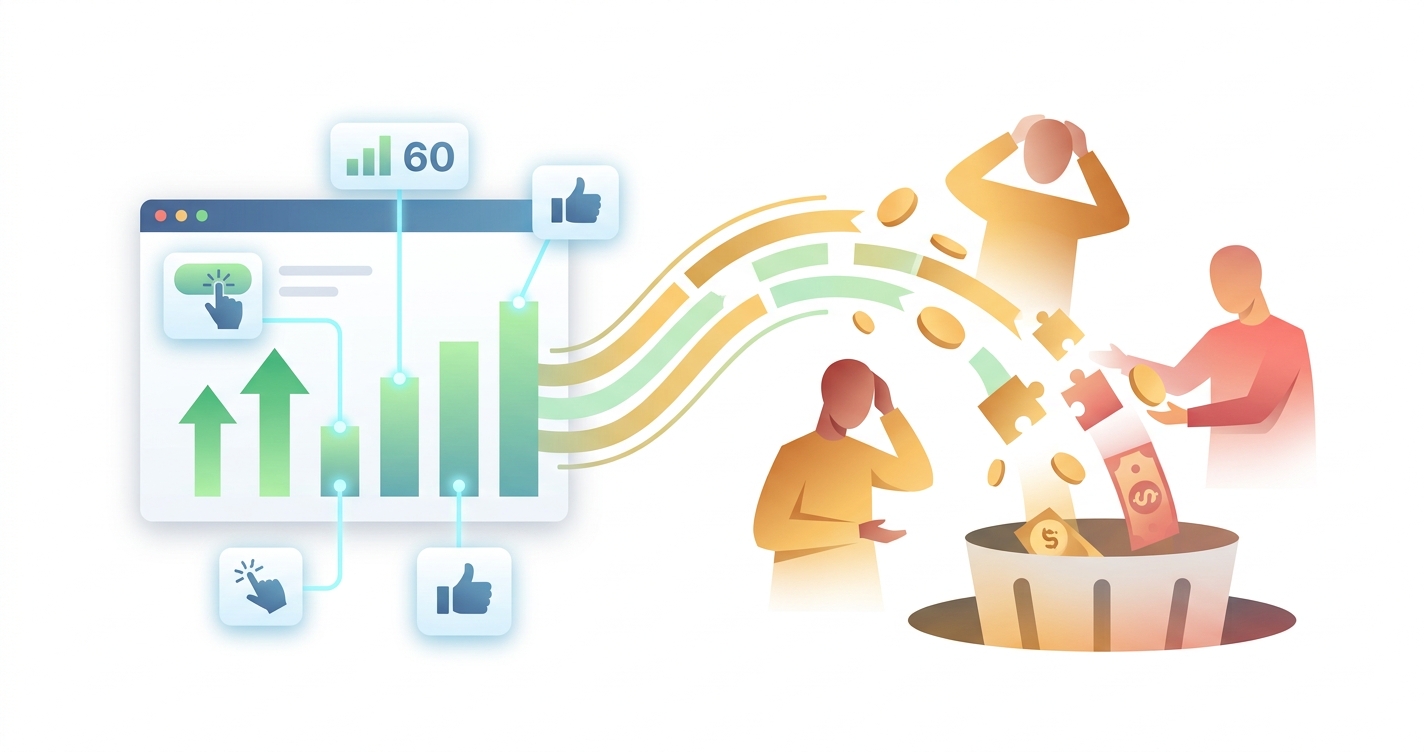
Many marketers celebrate campaigns packed with high click counts and strong engagement. They face disappointment when these “good numbers” don’t translate into leads or sales.
This false sense of accomplishment, driven by shiny dashboards, often hides an uncomfortable reality. Your ad budget might be fueling activity, not meaningful results. A reporting culture obsessed with surface-level metrics can mask underlying weaknesses, while genuine business value—actual leads and revenue—gets lost.
The Metrics Mirage: Why Vanity Stats Mislead Everyone
Metrics like impressions, clicks, and engagement rates are easy to track, easy to boost, and easy to celebrate. But these “vanity metrics” are notorious for hiding real performance issues.
Many organizations fall into the trap of equating volume with value:
- Clicks may signal interest but don’t guarantee conversations or purchases.
- Impressions reveal reach but not whether you reached the right audience.
- Engagements can be empty—likes, shares, and comments might come from people who will never buy.
The psychological lure is strong. Marketers under pressure to justify budgets often lean into “good” numbers to tell a positive story, especially when management equates activity with ROI. Teams become risk-averse, chasing incremental improvements in metrics that look impressive but don’t drive the bottom line.
Common cognitive and organizational traps include:
- Dashboard dependence: Mistaking metrics provided by ad platforms as the whole truth.
- Confirmation bias: Focusing on numbers that support a positive narrative while ignoring lagging leads or sales.
- Visibility gaps: Reporting only what’s easy to show, not what actually drives business outcomes.
What’s Happening Behind the Dashboard? Four Key Traps
Beneath the surface of impressive ad stats, several hidden challenges distort the real picture of campaign performance.
Invalid Traffic Is Only the Beginning
The industry’s focus on invalid traffic (IVT) is warranted. Globally, 8.51% of paid ad traffic is invalid, amounting to $63 billion wasted in the last year alone [1].
IVT rates vary drastically by platform and industry:
- TikTok: 24.2% IVT (highest among major platforms) [1]
- LinkedIn: 19.88% IVT
- X (formerly Twitter): 12.79% IVT
- Meta (Facebook/Instagram): 8.20% IVT
- Gaming faces 18.49% IVT, while Retail is at just 6.03% [1].
Invalid clicks—from bots, click farms, and fraud—are the most visible form of wasted spend. But addressing this threat is just the starting point. Even “real” human clicks don’t guarantee real outcomes.
Conversions Happen in Attribution Blind Spots
Modern customer journeys cut across channels, devices, and platforms. Ad platforms often lose visibility beyond the initial click.
Click to WhatsApp ads are a classic case. Once a user leaves the ad for WhatsApp, the conversation and any resulting sale vanish from Meta’s reporting. Offline conversions like calls, chats, or in-person visits require extra steps to connect back to the original ad.
When these events aren’t captured and sent back to Google Ads or Meta Ads, the platforms never learn what drove real business results. That disconnect means campaigns optimized for clicks—not sales—get more of your budget.
Privacy Changes Create Signal Loss
As browsers phase out third-party cookies and privacy regulations increase, tracking signals evaporate. Users opt out of tracking, and platforms are forced to limit cross-site identifiers.
This means fewer user journeys can be traced from ad exposure to conversion. Ad platforms’ optimization algorithms have less ground-truth data on what actually works, and the gap between dashboard stats and business KPIs grows wider.
AI Optimizes for the Wrong Signals
Ad platforms’ algorithms increasingly control campaign delivery, targeting, and spend. But these AI-driven systems only optimize for the signals they’re given.
If the most reliable conversion event you provide is just a click or a generic page visit, the AI will double down on generating more of the same. Campaigns that produce high engagement but zero paying customers can end up getting the lion’s share of your budget. Giving these platforms the wrong signals accelerates wasted spend.
Proving What Actually Works: Practical Diagnostics for Marketers
It’s possible to audit your campaigns and separate fake wins from true results with a systematic approach.
Conduct a Systematic Campaign Audit
- Map the customer journey. Trace every step from initial ad click to final sale. Identify where your reporting stops—it is often much earlier than you think.
- Tie conversions to business outcomes. Look for a direct link between ad-driven traffic and completed lead forms, qualified conversations, or purchases.
- Pull source data into one place. Export leads from your CRM, WhatsApp, or inboxes alongside your ad data. Do the leads match the campaigns in your dashboard?
- Check for gaps. A manual review can reveal missed sales not tied to ad clicks or inconsistent lead data.
- Compare traffic quality, not just volume. Use channels with lower invalid traffic—Meta’s 8.20% rate should give more confidence than TikTok’s 24.2% [1].
Measure for Business Impact, Not Clicks
- Qualified leads linked to an actual campaign or ad.
- Conversion rate from click to real conversation, not just to a page view.
- Cost per qualified lead or closed sale, traced back to the source ad.
- Revenue generated per campaign, not just impressions or clicks.
Adapt Your Approach for B2B vs. B2C
- B2B: Longer sales cycles make it easy to lose the trail from ad to sale. Focus on robust first-party data capture, such as unique tracking parameters tied through the entire journey.
- B2C: The customer journey is faster, but gaps still exist. Post-conversion surveys, coupon codes, or custom WhatsApp flows can help close attribution gaps.
Aligning your measurement to real outcomes—qualified leads, booked meetings, or purchases—is the only way to judge ad effectiveness.
Simple Actions to Shift from Illusion to Actual Results
You don’t need an enterprise tech stack to start closing the gap between metrics and reality.
Checklist for Refocusing Ad Spend and Reporting
- Audit every lead source. Can you trace each sale or qualified lead to a specific ad or campaign?
- Stop reporting on clicks and impressions as primary KPIs. Supplement them with business outcome metrics.
- Plug attribution leaks. Use UTM parameters, lead capture forms, or integrated tools that send conversion events back to Google Ads and Meta Ads.
- Monitor platform invalid traffic rates. Adjust budget allocations toward platforms proven to deliver cleaner traffic [1].
- Share outcomes with management. Present qualified lead and sale numbers, showing the difference between dashboard metrics and real business results.
How to Communicate Reporting Gaps
- Frame the conversation around optimization, not failure. “Here’s how we’ll shift our budget from generating clicks to generating actual leads.”
- Emphasize the opportunity to reduce waste. “Industry benchmarks suggest 8-25% of ad spend is wasted on invalid traffic, not even counting misattributed conversions [1].”
- Demonstrate incremental fixes. “We’re implementing steps to tie every WhatsApp or call-based lead back to the campaign that brought them in.”
Even with limited tools, marketers can avoid vanity metric traps and reclaim wasted budget by focusing relentlessly on real outcomes.
How HeyMotek Addresses This
HeyMotek bridges the gap between ad clicks and real leads by automatically matching each WhatsApp conversation to the Google Ads or Meta Ads campaign that drove it. Instead of relying on clicks alone, every new WhatsApp lead appears in a dashboard showing its full ad source. For Click to WhatsApp ads, the first message is traced directly with no extra setup.
This goes beyond standard platform reporting. When a lead becomes qualified or results in a sale, HeyMotek sends those outcomes back to the ad platforms. This ensures your ad algorithms—and your budget—shift to what really brings in business, not just traffic. Business owners and agencies can filter leads by campaign, search by phone, and export results, removing the need to manually reconcile ad spend with leads in spreadsheets.
With this attribution in place, you gain clarity into which campaigns create genuine business value. You can show clients real results, cut wasted spend, and focus your ad budget where it has an actual impact. Start Tracking
See which ads bring your real WhatsApp customers.
Free plan. No credit card required 👏
Start for freeRelated integrations